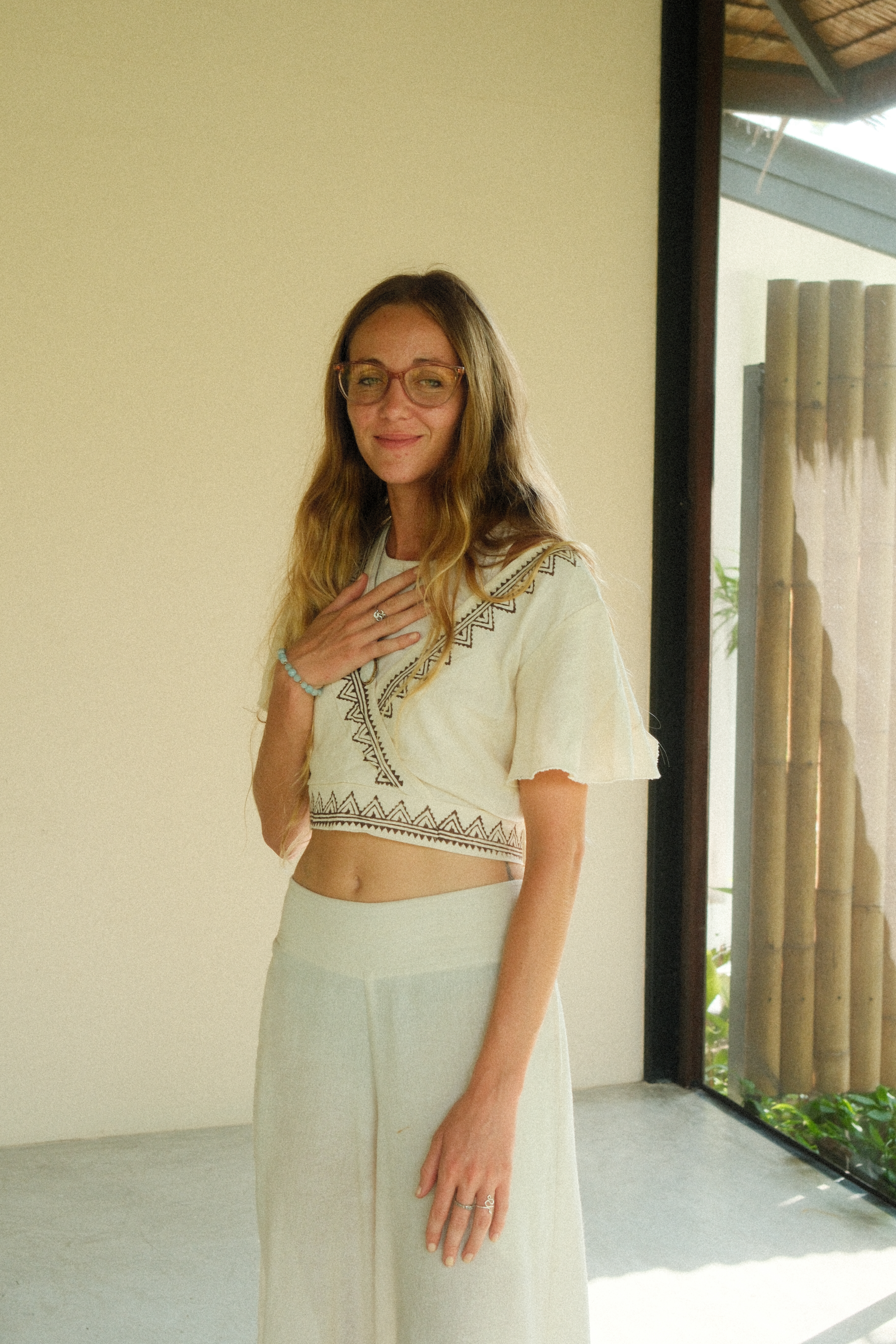
About
I teach the two things that gave me back my own time.
Breath and sound. Neither is complicated, and both have been quietly holding people together for a very long time.
I did not come to this work through a straight line. I came to it the way most people do — by getting tired enough that the usual answers stopped working.
For years I lived at the speed most of us are taught to live at: busy, productive, and quietly running on empty. I was not ill. I was not in crisis. I was simply never quite present, and I had started to accept that as normal.
The first time I noticed my own breath
Someone guided me through twenty minutes of slow breathing and I cried, which surprised me more than anyone. Nothing dramatic had happened. But for the first time in a long while I was unmistakably inside my own body rather than somewhere ahead of it, and the relief of that was enormous.
That was the beginning of a long, unglamorous apprenticeship. I practised. I read. I sat with teachers and asked too many questions. And gradually the practice stopped being something I did and became the way I meet the world.
Learning sound on Koh Phangan
The sound side of my work began at AUM Sound Healing Center on Koh Phangan, where I studied as a student — learning the gongs, the singing bowls and the discipline of playing for someone else's rest rather than your own performance. Playing a gong well turns out to be mostly about restraint: knowing when not to strike, and trusting that the silence between the tones is doing as much as the tones themselves.
It is a place that teaches by immersion. You are surrounded by people who take this seriously, and you learn as much from the rooms you sit in as from the instruction. I am still learning there.
Learning breath with Patricia (Udipti)
My breathwork training has come from my teacher Patricia, known as Udipti. What she taught me, more than any technique, is patience — that the breath is not a tool to force a state, but a relationship to be kept. She has a way of saying very little and shifting everything, and much of how I hold a room now comes from watching her hold one.
The breath does not need to be mastered. It needs to be met, and then it does the rest.
What I do now
I live on Koh Phangan and I work with people one to one, in small groups, on the beach at sunrise, and online with whoever is awake at the right hour. I play gongs and bowls. I guide breath. I sit with people while they rest.
I am not a doctor and I do not claim to cure anything. What I offer is simpler than that, and I think more useful: a little genuinely undisturbed time with yourself, and some practices small enough that you will still be doing them in six months.
If that sounds like something you need, I would be glad to meet you.
How I work
Warmth first. Technique second. Always at your pace.
I keep groups small, I keep sessions unhurried, and I adapt everything to the person in front of me. If you are pregnant, recovering from an injury, working through grief or simply exhausted, tell me — the practice is meant to fit you, not the other way around.
- No experience of any kind is needed, ever.
- You are always in charge and can stop at any point.
- I will tell you honestly if something is not right for you.
- Nothing here replaces medical care — and I will say so when it matters.
In practice
Where you will find me.
On the beach before sunrise, in a small studio with the gongs, or on a screen at whatever hour suits you.
Let's find the right way to begin.
Tell me a little about where you are, and I will suggest one specific thing rather than a whole menu.