Quality Dates with Yourself
Three short practices written out step by step, so you can keep the work going without me.
Ten to fifteen minutes each.

Breathwork
Breathing is the only part of your nervous system you can steer on purpose. I simply teach you how to steer it well.
Breathwork is the practice of breathing on purpose — changing the speed, the depth and especially the length of your exhale, in order to change how your body feels. That is the entire premise. Everything else is detail.
Your breathing is unusual in that it is both automatic and voluntary. You do it without thinking, and you can also take it over at any moment. That overlap makes it the one direct doorway into the part of your nervous system that usually runs without your input.
Breathing out is the brake pedal. When your exhale is longer than your inhale, you are telling your body — in the only language it fully trusts — that nothing is chasing you. In response, heart rate eases, blood pressure softens, digestion comes back online, and the muscles around the jaw and shoulders begin to let go.
None of this requires belief. It happens whether or not you are convinced, which is one of the reasons breathwork often works for people who have not been helped by thinking their way out.
People come to me for very different reasons, and most of them are not looking for anything spiritual. They are looking for relief that fits inside a real life.
It is not a good fit for everyone. If you are pregnant, have epilepsy, a cardiovascular condition, glaucoma, or have had recent surgery, tell me before you book — we will adapt the practice or point you somewhere better suited. Nothing I do replaces medical care.
It begins with a conversation. I want to know what you are carrying and what you are hoping for, because the session is built around that rather than around a fixed script.
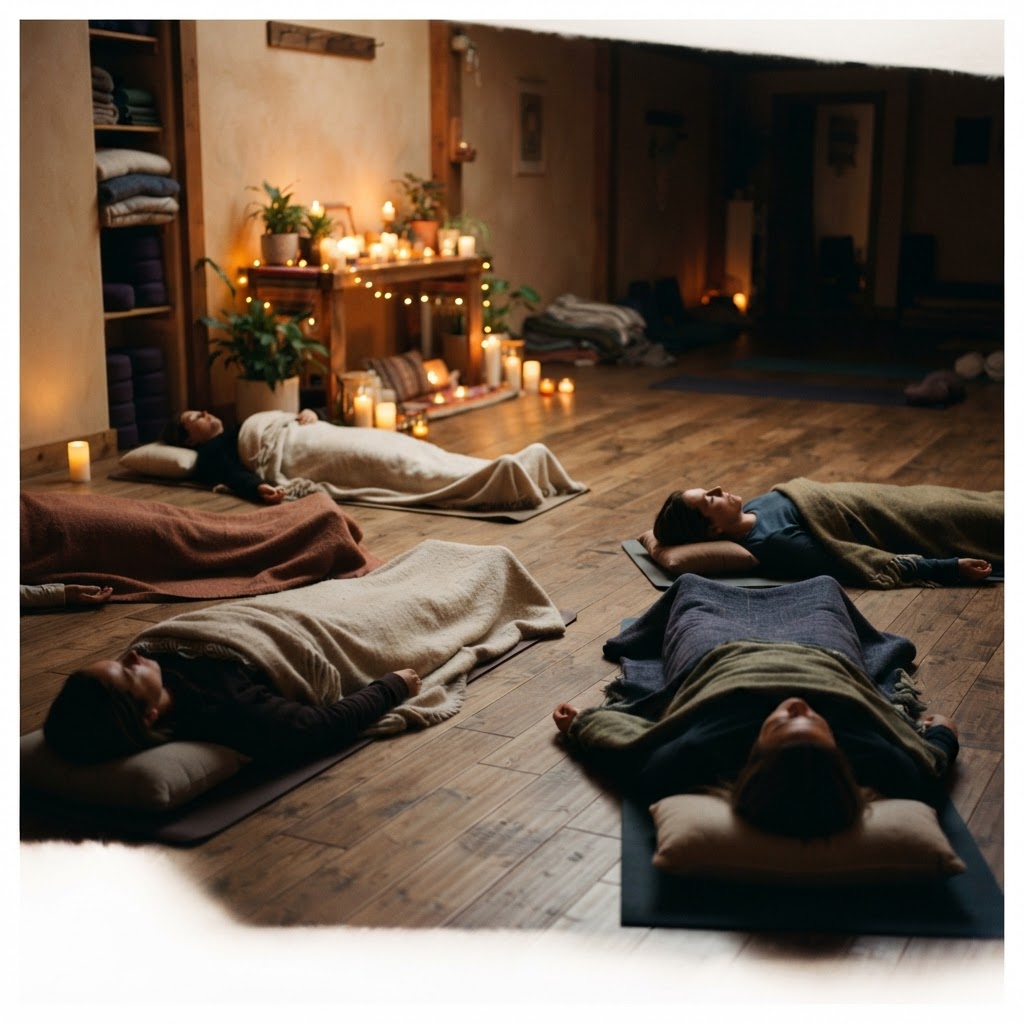
Then you lie down, usually with a blanket over you, and I guide you through breathing patterns chosen for your situation. You are never left to work it out alone. There are pauses. Sometimes there is silence for a while. Occasionally emotion moves through, and that is welcome rather than a problem. We finish slowly, sitting up only when you are ready, with time to say how it was.
People describe the feeling afterwards in fairly ordinary words: clearer, lighter, heavier in a good way, more like myself. Very few describe anything dramatic. That is usually the point.
Try it now
This is the pattern I begin almost every session with. Nothing is required of you except a minute of attention.
Ready when you are
Four in, four held, six out. Follow the circle and let it do the counting for you.
In the room
The most common thing I hear afterwards is that people had forgotten how much effort they were putting into holding everything together. In a session, that job is mine. You follow a voice, and the only decision you have to make is whether to keep going.
How to prepare
Leave an hour or two after a meal. A full stomach makes lying down and breathing deeply uncomfortable, and you will spend the session thinking about it instead of yourself.
You will mostly be on your back, so avoid anything tight around the waist. Layers help, because body temperature often drops during deep rest.
Have water nearby and arrive without a goal. You do not need to feel anything in particular, and trying to achieve a state is the fastest way not to reach one.
Pregnancy, injuries, conditions, medication, or simply that you are having a hard week. The more I know, the better I can shape the session around you.
Where this can go
Three short practices written out step by step, so you can keep the work going without me.
Ten to fifteen minutes each.
Contemplation that starts in the mind and finishes in the body, using your own profile as the map.
A signature two-session offering.
Live guided sessions you can join from anywhere, camera entirely optional.
Weekly, from wherever you are.
Tell me what you are carrying and I will shape the hour around it. No experience needed, nothing to prepare.