1:1 Sound Healing
A private journey shaped entirely around you, in a room where nobody else is listening. Ideal if you are working through something particular.
75 minutes, on Koh Phangan.
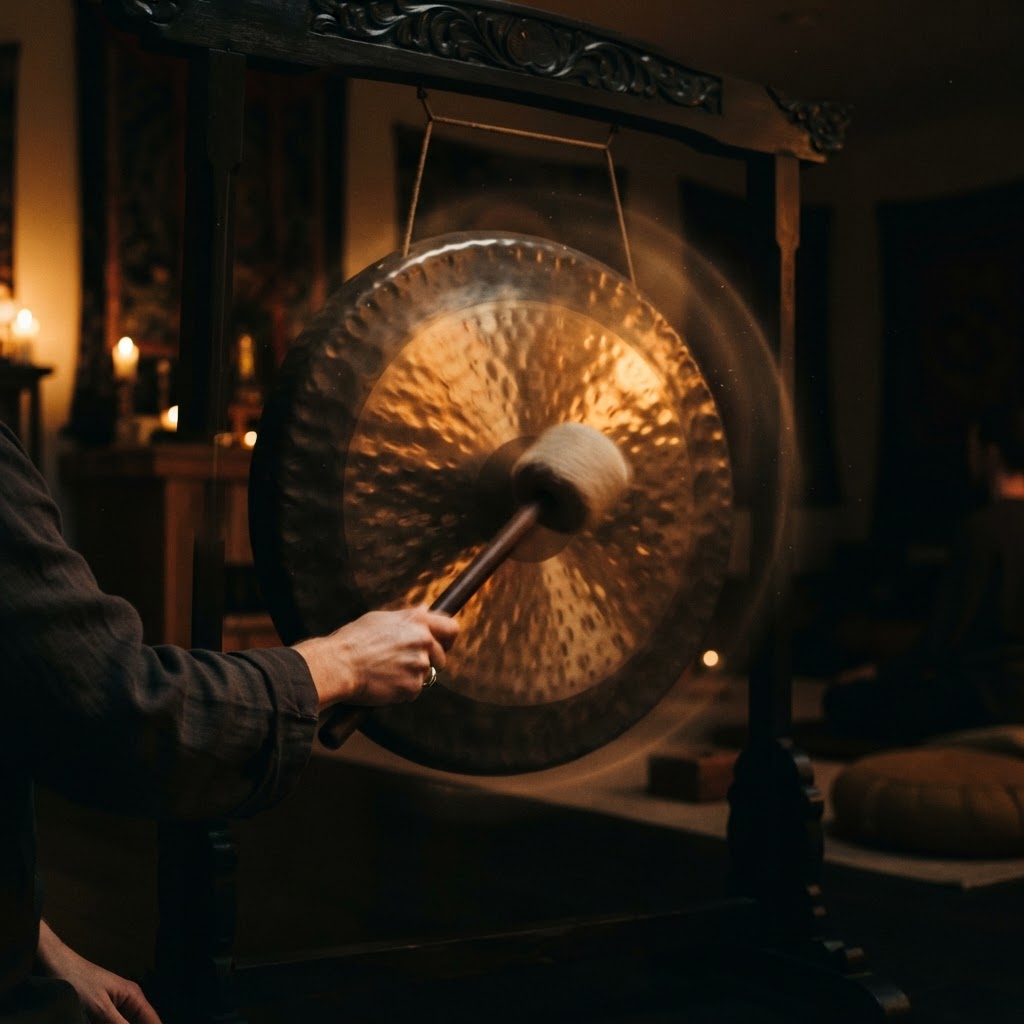
Sound healing
Gongs, singing bowls and voice, played around you while you lie down. Nothing to learn, nothing to get right.
A sound journey — often called a sound bath or gong bath — is an hour in which you lie down and let live sound move through the room around you. There is no performance and you are not an audience. You are simply resting while someone plays.
I work with gongs, Himalayan and crystal singing bowls, chimes and my own voice. The instruments are chosen for the room rather than a set list. Nothing is prerecorded, and no two journeys are the same.
A gong does not behave like anything else you hear. Its overtones shift constantly, overlap and decay unpredictably, so the mind cannot complete the pattern — and a mind that cannot predict what comes next eventually stops trying. That is when the internal commentary loosens.
Singing bowls add something different: long, steady, slowly evolving tones that give attention somewhere gentle to rest once the chatter has let go. My voice, used quietly, sits underneath both and holds the room together.
What happens is mostly the ordinary, well-documented response to slow rhythmic sound and genuine rest. Breathing deepens. Heart rate settles. Muscle tension eases without you consciously releasing it. Research suggests that slow, rhythmic sound can nudge brain activity toward the slower alpha and theta ranges associated with relaxed wakefulness and the edge of sleep.
I would not overstate it. You are not being repaired by frequencies. You are being given an hour in which nothing is required of you, in a warm dark room, with a mind that has nothing to grip — and that combination is rarer and more restorative than most of us admit.
You will be on your back on a mat, with a bolster under your knees if you would like one, a blanket over you, and an eye mask if the light bothers you. I will tell you when we are beginning and when we are finishing. Everything in between is yours.
You may drift. You may see colours or images. You may feel heaviness, or warmth, or a sudden wave of emotion. You may fall asleep — roughly half of everyone does, and it is not a failure to miss part of it. When the gong finally goes quiet, most people need a minute or two before they want to move.
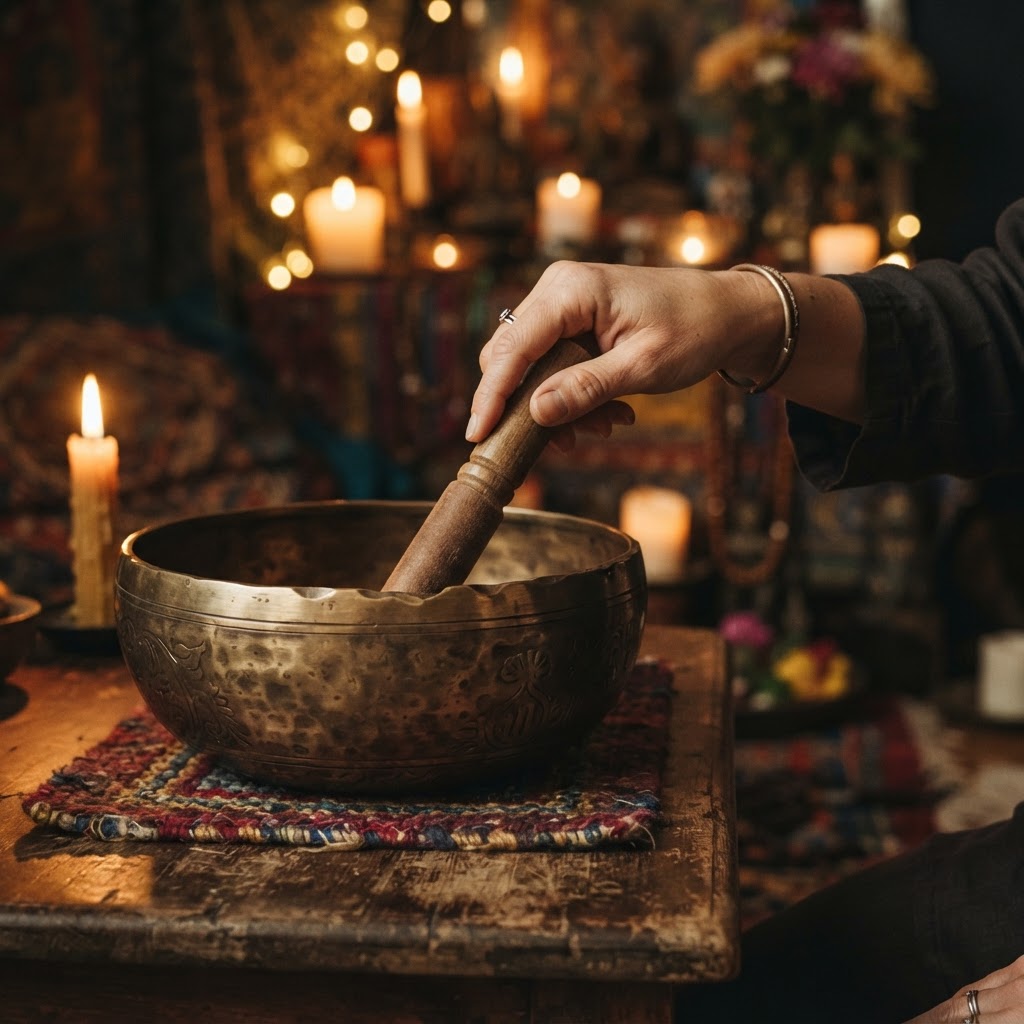
The setting matters
It is easy to credit the instruments entirely, but half the work is the conditions: lying down, low light, a blanket, eyes closed, and permission to do absolutely nothing. Those are the conditions most of us almost never give ourselves — and the sound is a very good excuse to allow them.
How to prepare
Nothing is required of you but lying down. Comfortable clothing helps, and you are welcome to bring a favourite blanket or cushion if that makes rest easier.
Gongs can be loud. If you have tinnitus, sensitivity to sound, or simply prefer quiet, say so — I keep ear plugs and I will play more gently for you.
Try not to schedule anything demanding straight afterwards. The rest is deep, and it is much better to keep the quiet going for a while.
Coming in slowly is part of it. A few minutes of silence before we start means you begin the journey already settled rather than catching up.
Ways to experience it
A private journey shaped entirely around you, in a room where nobody else is listening. Ideal if you are working through something particular.
75 minutes, on Koh Phangan.
Conscious connected breathing to release what the body has been holding, then gongs and singing bowls to carry you into deep rest.
AUM Sound Healing Center, Tuesdays & Thursdays.
A monthly evening journey timed to the full moon, with candles, blankets and a longer, deeper arc of sound.
Monthly, see the events page.
The gong journey is the easiest way in — no experience, no participation, nothing to bring but yourself.